Winter Wonderland

Cadence

Calabash was bred to Apollo and is due in February, and getting bigger every day.  She is now dried off as her body prepares for the miracle of birth.  Her triplets of last spring were beautiful with wonderful personalities.  The owners' of one of her kids from last season say that the little wether has the sweetest personality of any goat they ever owned!  We can attest that Cadence also has her mother's affection, as well her curiosity and penchant for mischief. 

Kizzy and Trillium were both bred to a blue-eyed buck last month, and we'll know in a few weeks whether they settle.  This was the first time using the new buck God's Love James.  He has a calm, steady personality and seems to be the right match for both Kizzy and Trillium.  Now in her second lactation, Kizzy is our top milker.  Her milking records have proven her terrific milking ability and long lactation!  We are now milking her once/day, and she is still giving a steady quart every morning.  Trillium is another girl with quality genetics, and I'm hoping some of her offspring will have blue eyes.  Christine from CapsandCreamery says that Titanium, Trillium's doeling from last season, is the strongest and fastest growing kid from her 2012 group.  Titanium also has stunning black markings and her dam's beautiful sky-blue eyes.

The girls love their pine needles and daily walks in the winter.  Exercise is important for the health of pregnant does.  Their dense winter coats keep them warm in the often below freezing temperatures.  When Cadence puffs her hair up in the morning she resembles a strange kind of polar bear.  Cadence sometimes races with our yellow Labrador Hudson, though neither knows where the finish line is.  They also love treats of crunchy carrots & turnips from last summer's garden.  Happily for now, summer is a distant memory in this winter wonderland.   


Chickens & Ducks:


Heritage Breed Buckeye (ALBC threatened list). These chickens are friendly and active,a favorite of ours.


Barred Rock and Delaware


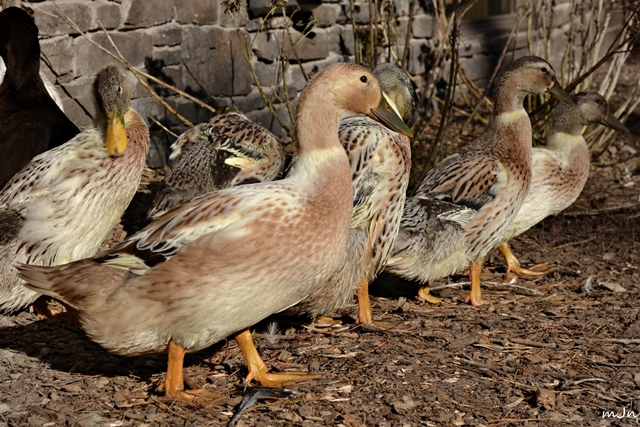
Welsh Harlequin Ducks (ALBC critical list)

*ALBC stands for the "American Livestock Breeds Conservancy" - ALBC website

"The American Livestock Breeds Conservancy protects genetic diversity in livestock and poultry species through the conservation and promotion of endangered breeds. These rare breeds are part of our national heritage and represent a unique piece of the earth's bio-diversity. The loss of these breeds would impoverish agriculture and diminish the human spirit. We have inherited a rich variety of livestock breeds. For the sake of future generations we must work together to safeguard these treasures.

These breeds are threatened because agriculture has changed. Modern food production now favors the use of a few highly specialized breeds selected for maximum output in a controlled environment. Many traditional livestock breeds have lost popularity and are threatened with extinction. These traditional breeds are an essential part of the American agricultural inheritance."


2012 Kidding Season

Record of 2012 Kids

Our first doe delivered on March 28, 2012.  Calabash had a set of triplets, 1 doeling and 2 bucklings.  Our second doe delivered on April 5, 2012.  Kizzy had a set of twins, 2 bucklings.  All kids were strong, healthy, and incredibly snuggly and cute!

Sleepy Mama - a few days before giving birth

Almost time!  TRIPLETS!!!

Cadence - our first doeling!

Kizzy's little one - Sold as a wether
Cala's triplets, cute bunch!
Cadence loves to cuddle
Brothers - Sold as wethers
Post-feeding, pre-naptime


Kizzy's little one - Sold as a buckling

Bottlefeeding

Spring 2012 kids are sold.  Cute and healthy!

Walk in the Autumn Woods

One of the most fun things about owning goats is taking them on a walk in the woods.  Goats are natural browsers like deer, as opposed to grazers such as cattle.  Goats prefer to reach upward for their food, rather than down to the ground.  This is a natural instinctual response, as goats are less likely to pick up parasites when reaching for tree branches and brush, than from close-cropped pasture ground.  In The Complete Herbal Handbook for Farm and Stable, Juliette de Bairacli Levy writes:  "A health rule for goat care is to walk the herd ... through woodland.  When trained, they will not stray from their keeper and that herbal and twiggy-eating walk will ensure them great health."  It is amazing to know that goats have a natural instinct as to what is healthful for their bodies, and harmful.  The herd queen will check out any new plant and determine whether it is suitable, and the rest of the herd will then follow her lead.  

inquisitive


Nutritionally and physically, not only is a walk in the woods healthful to the goats, it is also enjoyable for the goats and their owners!  I love evening walks with the herd because that's when they display their most entertaining antics and their individual personalities are on full display.  Herd queen Kizzy is alert, ears pricked and eyes sharp, making sure there are no threats to her companions.  Daredevil Cala takes the lead exploring new paths and scrambling on tree trunks and rocks.  Trillium is the best forager, probably because at her former home, Christine also led her goats on daily walks in the woods.  Kizzy and Cala keep an eye on whatever Trillium finds and have to have a chomp too.  On the walk, little Cadence displays her full name meaning to perfection.... she prances and caprioles with rhythm beside the older goats.  The goats love to play-fight with one another, bounding up on their hind legs and butting heads, reminiscent of their distant mountain goat ancestry.  When they have eaten their fill of blackberry and raspberry brambles, wild strawberry vines, pine needles, beech leaves, herbs and weeds, they will often lay down on a bed of soft pine needles and gaze with contentment at their surroundings.  Then a few moments later they will be up with a bound, ready for another forage, or to demand that I give them some attention.  And when the sun sets behind the horizon and the light begins to dim, back we go, all in a row, down the woods path.

Cala

noble, calm, herd queen royalty


mama and doeling


sweet Trillium, reflecting autumn's golden glow


eyes of  honey-gold


Why Raise Nigerian Dwarf Goats?

The Nigerian Dwarf as a Miniature Dairy Goat
The Nigerian Dwarf is a miniature dairy goat of West African origin. Nigerian Dwarf goats are enjoying a rise in popularity due to their small size, colorful markings and dairy characteristics. Their small stature means they do not require as much space or feed as their larger dairy goat counterparts and their gentle and friendly personalities make them good companion pets. The milk is also higher in butterfat and has a sweeter taste. Nigerians are easy to handle; even for small children. Nigerian Dwarfs are considered rare by the American Livestock Breeds Conservancy. The U.S. Department of Agriculture has also approved the Nigerian Dwarf Goat as a livestock dairy goat, which makes them eligible for youth 4H and FFA projects.

A healthy Nigerian Dwarf doe can produce a surprising amount of sweet milk for her small size - up to two quarts per day or more. In addition, Nigerian Dwarf milk is higher in butterfat (6-10%) and higher in protein than milk from most dairy goat breeds. Many Nigerian Dwarf owners raise their goats for milk production but others raise them for the pleasure and companionship these little caprines bring to their lives.

--Nigerian Dwarf Goat Association


What is a Wether?

A wether is a castrated male goat.
Wethers make great pets!  They are adorable, gentle, do not stink or become aggressive like a buck in rut.  Single goats need a companion and buddy.  Wethers should always be purchased in pairs if you do not have any other goats.